


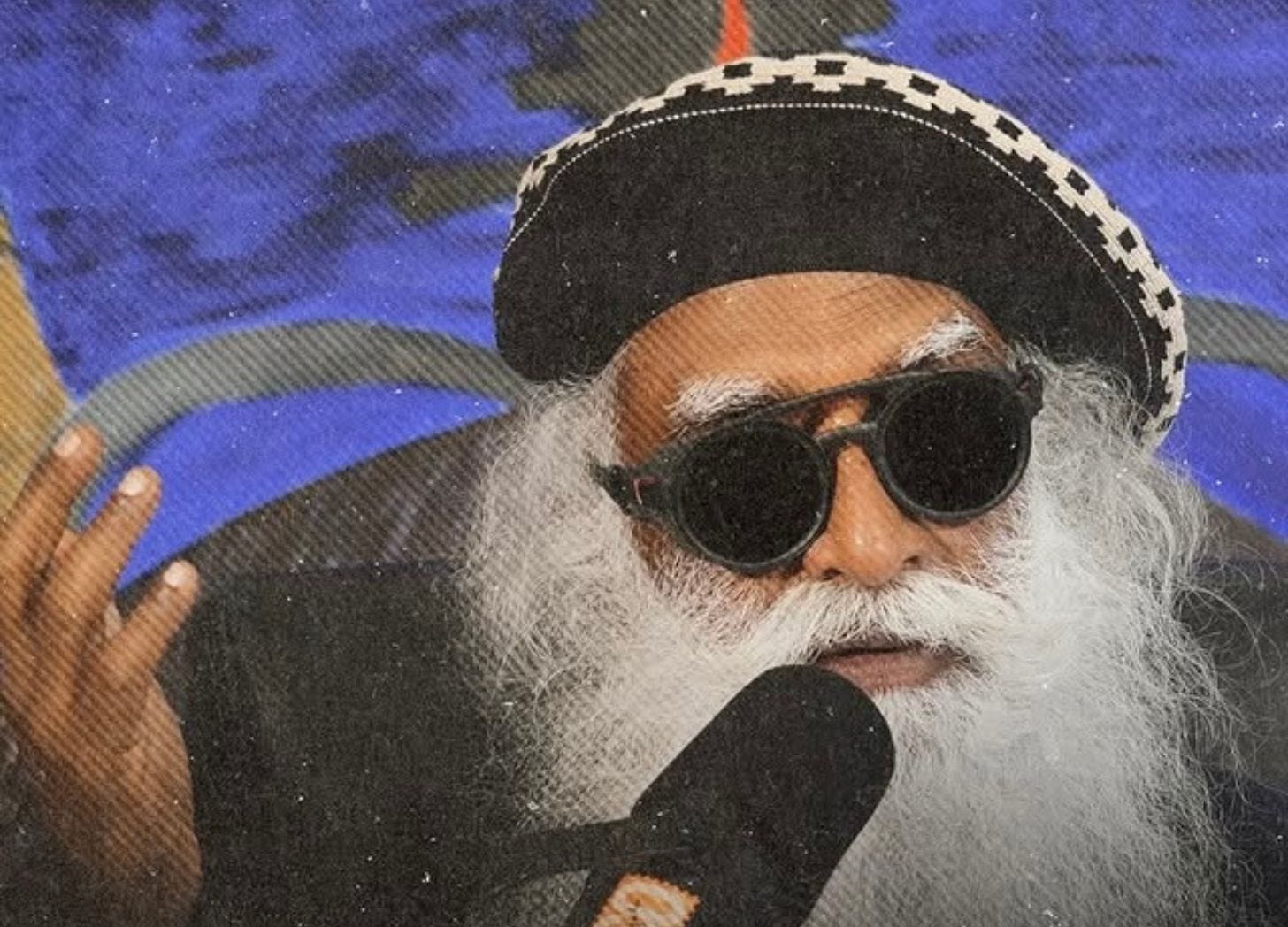
I’m Be Scofield, founder of The Guru Magazine and the journalist behind the hit HBO series on the Love Has Won cult. I’ve spent a decade reporting on spiritual power, abuse, and the machinery that protects it. My investigations have been cited by The New York Times, Rolling Stone, The Washington Post, People, VICE, Netflix, Dr. Phil, Dateline, and more. I’m the author of the new book The Savior Complex: How Jesus Became the World’s Ultimate Influencer.
Isha Foundation Inc., Sadhguru’s U.S. nonprofit branch, reported $190.6 million in assets at the end of 2024 — up from $57.5 million in 2020. If its recent growth continued, the American organization is now likely worth more than $200 million. It also held nearly $60 million in cash at the end of 2024—profiting $30 million that year alone. If that cash-growth pattern continues, its cash reserves could approach $120 million by the end of 2026.
And that is only the U.S.; the India branch dwarfs the American by three or four times.
Isha began in India in the early 1990s. Its Coimbatore headquarters, Isha Yoga Center, ashram, and Adiyogi complex have become major pilgrimage and tourism hubs. As many as 8 million people reportedly visit the center and Adiyogi complex each year—a number that drastically outsizes Isha’s U.S. activities. Its annual Mahashivratri celebration draws crowds in the hundreds of thousands, with official reserved seating tiers ranging from about $5 to $525.
Given the massive scale of Isha’s India operation, the U.S. branch may represent only a fraction of Sadhguru’s global enterprise. With dozens of Isha entities and centers around the world, paid programs, expensive spiritual merchandise, and Sadhguru’s personal wealth, the worldwide Isha ecosystem could plausibly be worth close to $1 billion.
But the public has no consolidated balance sheet for Sadhguru’s empire. In the United States, nonprofits like the Isha Foundation have to file public Form 990 tax returns—in India, such disclosure is not required. Sadhguru, widely marketed as a humanitarian and spiritual leader, has not publicly released the value of Isha worldwide or his personal net worth.
What we do know is how much of this empire was built by unpaid labor.
Sadhguru created Isha largely by convincing idealistic followers that working for him was service to the cosmic mission of “raising human consciousness.” Isha says it has 4,600 full-time volunteers, and its website has boasted of 18 million volunteers worldwide. “We worked for no money every single day,” a former staff member named Drew told me. Sadhguru had convinced his followers that if they worked for him, they were saving the world.
In 2024, only about 5 percent of Isha’s U.S. revenue was distributed as grants: $2.56 million in foreign grants and just $21,499 in domestic grants. And even “grants” is opaque. The filing does not clearly show whether that money went to direct charity, Isha-linked entities, or some other purpose. It is also unclear what percentage of Isha’s India-side or global revenue goes to conventional charitable aid.
And despite Isha’s immense reserves, Sadhguru continues to ask followers for more.
One of the clearest examples is Ishanga, Isha’s tithe-like program, where followers give 7 percent of their annual income to Isha. Sadhguru heavily pushes this initiative. In a remarkable video on the Ishanga page titled “Establish a Bond of Grace with Sadhguru,” he tells followers that living with 7 percent less income will actually help their spiritual growth.
“This is not about me taking your 7%,” he says. “Do I look so incompetent that I have to sit and collect 7% tax from you? I’m not made like that. If I want, I will make what I want.”
Then he explains the real purpose of the tithe: spiritual transformation.
“If you reduce it at least by 7%, we can do something else with you,” he says. “This is a simple device for you to breach the boundary of what is me and what is mine… to breach the boundaries of who you are so that something far bigger than you becomes a part of your life.”
This is a form of spiritualized extraction—give up your money, and the master’s grace enters your life. Keep it, and you remain trapped in the small world of “me” and “mine.”
The dynamic is reminiscent of the Mormon Church, which built vast wealth while requiring members to tithe 10 percent of their income. In 2023, the SEC fined the church and its investment arm, Ensign Peak Advisers, $5 million after finding that they used shell companies to obscure a stock portfolio that had grown to about $32 billion by 2018. Later reporting and whistleblower allegations suggested the church’s total reserves may exceed $100 billion.
For many former and questioning Mormons, the scandal was that everyday believers had been urged to sacrifice income and savings while leaders quietly accumulated vast tax-exempt wealth.
Isha now faces the same question.
Sadhguru’s organization has over $100 million in cash and may be worth $1 billion in total, but he really needs 7% of the incomes of his ordinary followers. What is all this money being used for? And do the followers know?
He tells a group of followers that with 7% less income, they will be better able to achieve spiritual growth.
Isha highlights charitable projects it has started or inspired—rural schools, tree planting, soil campaigns, river campaigns, and rural health care. But these projects appear to operate through their own ecosystems: separate entities, staff, budgets, donation portals, corporate sponsors, government partnerships, and volunteer networks. Isha’s rural healthcare or mobile health clinic page thanks corporate donors including Hero FinCorp, New India Assurance, and CG Power and Industrial Solutions Limited.
Sadhguru’s organization has over $100 million in cash but he really needs 7% of the incomes of his ordinary followers
As noted, Isha U.S. alone profited $30 million in 2024, with only $2.56 million given in the opaque category of “grants.” That’s only 5%—and it’s unclear if these are even charitable givings.
A guru-led organization can receive the reputational benefits of charity without funding those projects from its own reserves. Sadhguru can point to schools and trees or soil campaigns as proof of Isha’s public service, while the funding comes from separate donors, corporations, or even government programs. It doesn’t mean that Sadhguru or Isha funds these charitable operations.
Selling the Divine
Donations and tithing are a significant percentage of Isha’s millions—but Sadhguru also sells divine merchandise.
He sells access to the divine feminine in the form of the Bhairavi Mukha, a 20-inch copper plate for $3,333. It is “an overpowering presence of the divine feminine,” the sales page states. “It’s an opportunity for every devotee to connect with Devi through this powerful form and experience her Grace.”
Former followers of Sadhguru report buying $18,000 yantras sold by Sadhguru. They supposedly act “like antennas to the main source of energy, which is the main temple in the India ashram,” a former monk told me. “The Sannidhi has a miraculous impact on the internal and external well-being of all who come within its sphere,” Sadhguru claims.
What Happened to Sadhguru's Wife?

Did Sadhguru's wife die from enlightenment, as he claims, or was it foul play?
The special Avingha Yantra pricing is $1,100 when you sign up for the Avingha Yantra Sadhana weekend for $8,600. “The Avighna Yantra creates a powerful presence of Devi and consecrates the home or office, enabling all to bask in her Grace,” his site states. “The [Avingha] sadhana helps to lubricate your actions with Devi’s Grace, so that you can enhance your business and personal or spiritual life to its full potential.”
The real sales gimmick is “consecrated” products—things that either Sadhguru or the gods bless.
A small consecrated gold pendant costs $1,777. Other consecrated pendants range from $199 to $1,555. He also sells a consecrated Rudraksha bead for $395. You can purchase them elsewhere for $1 to $50. A gold snake ring will set you back as much as $1,900. “This consecrated gold snake ring brings stability to the body and foundational support for your sadhana,” the page states. “Simple yet profoundly effective, it’s your companion for opening to higher possibilities.” The “Ambiance of Grace” gift set, consisting of a small oil lamp and a mini Dhyanalinga Yantra, costs $444.
Sadhguru also sells a 2.5 ft tall “consecrated” aluminum statue of Adiyogi for $10,000. “Each statue is consecrated to create a certain reverberation in your home or office,” the sales page states. “The statue will be a powerful reminder of the higher possibilities within a human being and orient oneself towards that goal.”
He also sells shampoo, incense, herbal jams, skincare products, backpacks, bangles, and bracelets.
There’s more. Sadhguru also sells photos of his feet.
In October 2024, Sadhguru attracted criticism for selling photos of his feet for $100. The sales page says the photo is “a powerful medium to strengthen your connection with Sadhguru.” He also sells impressions of his feet for $1000. "Bring Sadhguru’s presence home with a Sadhguru Sannidhi pada yantra," Isha Foundation stated in an Instagram post. The 2 ft x 2 ft yantras are crafted from stone, brass, or mercury and have impressions of his feet on them. The yantra "creates a powerful energy within one’s home that significantly enhances one’s progress on the spiritual path," according to Sadhguru.

To travel with him on the 13-day Kailash sojourn to the Himalayas, it costs $58,000 US dollars. Other trips range from $3,000 to $7,000 but only include a one-time meeting with Sadhguru. Isha's annual Mahashivratri festival brings in tens of millions of dollars. Some spend thousands on tickets to the 4-day festival, which sees an in-person attendance of hundreds of thousands. Millions tune into the livestream.
A Religious “Nonprofit”
Public tax records show Sadhguru has built a massive spiritual empire through tax-exempt donations, paid programs, expensive spiritual merchandise, and millions of hours of unpaid labor. The U.S. wing alone reported nearly $100 million in land, buildings, and equipment—up from about $22 million in 2020. Globally, Isha and Sadhguru’s ecosystem could plausibly be worth close to $1 billion when its Indian ashram, Adiyogi complex, real estate, international centers, his net worth, and related entities are taken into account.
With this amount of wealth, why are the people running Isha still working for free? And why is Sadhguru still asking ordinary followers to give 7 percent of their income?
Despite being lauded as a humanitarian leader, Sadhguru has never publicly released a consolidated accounting of how much Isha is worth worldwide or how much of its wealth actually funds charity. Isha points to charitable programs, but separate donors fund them. While Isha enjoys a humanitarian halo, the public remains in the dark about the full checkbook.
What the filings do show is that Sadhguru appears far more invested in building a “yogic” city in Tennessee than in operating a conventional charity. For years, Isha has been expanding its McMinnville center with new buildings, apartments, studios, retreat infrastructure, and land. He envisions tens of thousands living there. It’s clear he’s interested in building institutional power—not proper charity.
If Sadhguru avoided heavily pushing a 7 percent tithe, soliciting donations worldwide, relying on unpaid labor, and marketing himself as a humanitarian, perhaps there would be less reason for scrutiny. But when a guru-led nonprofit accumulates hundreds of millions in visible and probable assets while asking followers to surrender income and labor in the name of grace, scrutiny is warranted. The valid question is who funds Isha’s charitable projects and how much do they contribute to them? How much have they profited while still asking followers for significant contributions and basking in the public perception of being humanitarian?
What this investigation reveals is a troubling loophole in the nonprofit world: a religious or spiritual organization can raise enormous sums in the name of public charity while retaining most of the money for its own power and expansion.
READ THE SERIES:
Part I: Inside Sadhguru’s Cult Empire
Part II: Unmasking Sadhguru’s Legacy of Abuse
What Happened to Sadhguru’s Wife? - Did Sadhguru’s wife die from enlightenment, as he claims, or was it foul play?
Why Sadhguru Never Mentions His Yoga Teacher - Sadhguru studied with a yoga teacher for years in the 1980s, rebranded his system as his own, and never gave credit.
I don't understand why people fall into these cults time and again. People gotta start using their brains more
Yes 🙏🏼
Just because Sadhguru's methods work people who follow him think everything about their Guru is True and this is where the problem lies.
Here are some more references:
Isha might end up paying defendants' fees/costs $350,000.
Not sure about 600 Million Spent To Defame Sadhguru!
But Isha Foundation is sure spending a lot of money filing defamation case and lost the case.
https://x.com/grok/status/2026294095946162349?s=20
ISHA FILED A DEFAMATION CASE in USA but LOST THE CASE.
Isha failed to show prima facie case (falsity + actual malice) against former devotees Neeta Jaikanthan, husband Jayakanth alleging misconduct, sexual abuse claims against Sadhguru.
Official Tennessee court records for Hamilton County Circuit Court, Docket No. 25C317 (Isha Foundation Inc. v. Jaikanthan Sankaradass and related parties, including Neeta Jaikanthan/Neeta Tiwari).
Portal: [https:pch.tncourts.gov/]
(Public Case History search tool for Tennessee courts).
Search by case number 25C317 in Hamilton County Circuit Court.
Not sure about the court fine.
But Isha filed defamation case saying they were defamed and they lost the case. Isn't it obvious, a Spiritual organisation with some of the most responsible & sincere spiritual folks wanted to stop ex Isha Ashram folks from sharing their experience.
How come Sadhguru, a person with absolute clarity, then the many other responsible and spiritual folks, sadhaks etc. in Isha foundation don't know difference between defamation and criticism.
I mean why Isha foundation would just file a defamation case unless it is so obvious that the defamation or comments were really crossing the line.
It is not that Sadhguru and Isha foundation are not at all ridiculed, mocked, criticised - that too being a public figure and that too being a non profitable organisation they know they cannot silence all useless folks who speak against them but Isha foundation should be more thoughtful and responsible with donors money.
But how hard or simple is it for a leading NGO in the world, & for someone who claims to be a highly capable spiritual person like Sadhguru and with an entire team of responsible folks around him dint know if the defamation case they filed spending donors money would not back fire on them or atleast had some substance.
Just saying how hard is it for a highly spiritual person, an world famous NGO & with all the capable minds & spiritual folks in the Isha foundation know if this was worth spending donors money to file a defamation case?
How come Sadhguru a person with absolute clarity doesn't know difference between defamation and criticism.
SADHGURU FAKE STORY REBIRTH.
Sadhguru used to tell a story around his “past life” as “Sadhguru Sri Brahma”.
https://www.facebook.com/share/r/1DCWyWVCvb/
In the story, Sadhguru Sri Brahma is trying to create a temple called Dhyanalinga. He states that “Sadhguru Sri Brahma” temporarily took on another body of a bala yogi from Maharashtra named Balayogi Sadananda from Vajreshwari to help achieve this goal of creating Dhyanalinga. After being unsuccessful despite taking on the body of this Balayogi Sadananda from Vajreshwari, Sadhguru Sri Brahma leaves that second body. He even goes on to state that he kept a photo of that Bala Yogi Sadananda in his car to remind him “Not to get angry in this lifetime”. This story is a complete fabrication & the timelines don’t add up at all!
Sadananda is still alive to this day! He even has an instagram and facebook page.
Balayogi Sadanand from Vajreshwari was born after Sadhguru and is alive even today.
Sadhguru Sri Brahma lived from 1878-1920. Balayogi Sadananda was born around 1955, making him about the same age as Jaggi Vasudev! A simple Google search today will reveal that the Balayogi from Vajreshwari that Sadhguru claims to be was not only born after Sadhguru (leave alone his past life) but is alive today and a known saint in Maharashtra! So the assertion made by Sadhguru that Sadhguru Sri Brahma inhabited the body of this Balayogi Sadananda is completely made up.
DHYANLINGA IS A LIE AS WELL.
Sadhguru in his book #MysticsMusings says #Dhyanalinga is CITED in #Rigveda?
Is there any mention of such Linga or refer to Dhyanalinga, a linga consecrated, to be consecrated or consecrating with 7 chakras at peak in Rigveda
Mystic’s Musings (pp. 223–224) says that Dhyanalinga is “cited in Rigveda.”
Sadhguru's claim in "Mystic's Musings" (pg 223–224), he states Rigveda mentions in one sentence that a Dhyanalinga can only be created by a grihastha yogi. However there is no such reference to Dhyanalinga or a linga with 7 chakras.
SADHGURU SPIRITUAL GURU PALANISWAMY NEVER EXISTED.
Sadhguru’s spiritual Guru who touched him with a stick and Sadhguru got enlightenment. No such person or anyone as Sadhguru says existed.
Not even Siddha or non traditional Hinduism.
No such story ever heard about a person called Palaniswamy. Sadhguru says his Guru Palaniswamy had such spiritual prowess that more people visited his Guru instead of the Deity. Till date no such folklore, no iota of such Yogi or anyone by that name matching Sadhguru's claims.
Palani Murugan Temple is world famous. No iota of such a person in Palani Temple's history or Hindu folkore. End of topic.
NEXT MALADIHALLI RAGHAVENDRA FROM WHOM SADHGURU LEARNT YOGA WAS EXPOSED
Next Maladihalli Raghavendra is a person Sadhguru says he learnt yoga itself is a proven time pass yogi & exposed.
Karanth & Raghavendra were contemporaries in Karnataka and had a documented association in the 1920s or early 1930s at the Amba Prasaditha Nataka Company in Tumkur. Karanth, a budding artist, introduced Raghavendra to Ranganatha Thamankar, who gave Raghavendra a clerical job.
Ten Faces of A Crazy Mind - Page 581 to 590 Raghavendra took few ideas of yoga, Karanth says in his book.
Malladihalli Raghavendra fakery - claimed to have taught yoga to over 4.5 million people and treated 3 million with ayurvedic remedies but was a big time pass yogi himself exposed by Kota Shivaram Karanth (10 October 1902 – 9 December 1997) polymath, novelist, playwright, ecological conservationist - known as Rabindranath Tagore of Modern India
Malladihalli Raghavendra was just doing yoga for ticket sales.
Raghavendra later left this job to pursue spiritual and yogic pursuits, including learning from Palani Swami. (Who never existed).
Point is Maladihalli Raghavendra itself is a proven gimmick artist & just learnt a few yoga tricks to make a living was exposed big time that he is just doing yoga for money then why do this for a saintly image. Palaniswamy never existed.
A writer stature of Nobel Prize winner Rabindra Nath Tagore & even called as Rabindra Nath Tagore of Modern India published a book. Get it.
He writes Maladihalli Raghavendra is a time pass yoga guru and the book is published all over Karnataka.
Yet ironically Sadhguru says he learnt yoga from him. Yet again a controversial figure. Palaniswamy never existed, Balayogi is alive, & Raghavendra was a time pass yogi.
So both Gurus of Sadhguru are having no credibility and Palaniswamy did not exist at all.
Sadhguru says "seek & dont believe". I seeked & found NOTHING! Sadhguru's credibility? Some one just show in Rigveda mentioned about Dhyanalinga?🙏
SADHGURU OR ANY OF HIS BRAHMACHARI OR HIS BEST DISCIPLES PROVE THEIR SPIRITUAL TENACITY
Simple. Sadhguru in his biography says he made a hairline crack on the Dhyanalinga just by clapping.
https://youtube.com/shorts/tFCB8wH-E0o?si=yHgX167jUhadkIx9
Let Sadhguru or anyone of his disciples do it & show. Let them take years.
Same quality density, size, shape stone. Take the same years of Sadhana, preparation etc if they want.
For now personally I would NOT RECOMMEND Sadhguru. No hard feelings or partiality. Just my clear experience and knowledge about Sadhguru since 2014, just too many red flags. It's crystal clear again that Sadhguru has way too obvious red flags.