


I’m Be Scofield, founder of The Guru Magazine and the journalist behind the hit HBO series on the Love Has Won cult. I’ve spent a decade reporting on spiritual power, abuse, and the machinery that protects it. My investigations have been cited by The New York Times, Rolling Stone, The Washington Post, People, VICE, Netflix, Dr. Phil, Dateline, and more. I’m the author of the new book The Savior Complex: How Jesus Became the World’s Ultimate Influencer.
At the end of Christopher Nolan’s The Odyssey, Matt Damon’s Odysseus returns to his own kingdom disguised as a beggar. Disheveled, with a scarf pulled over his head, he moves through the palace unrecognized. People soon mock and shove him while others insult him.
Odysseus is actually the rightful king—powerful, wise beyond measure, and finally home. The disguise serves as a test of character. How do people treat a stranger when they believe he has no status and no power?
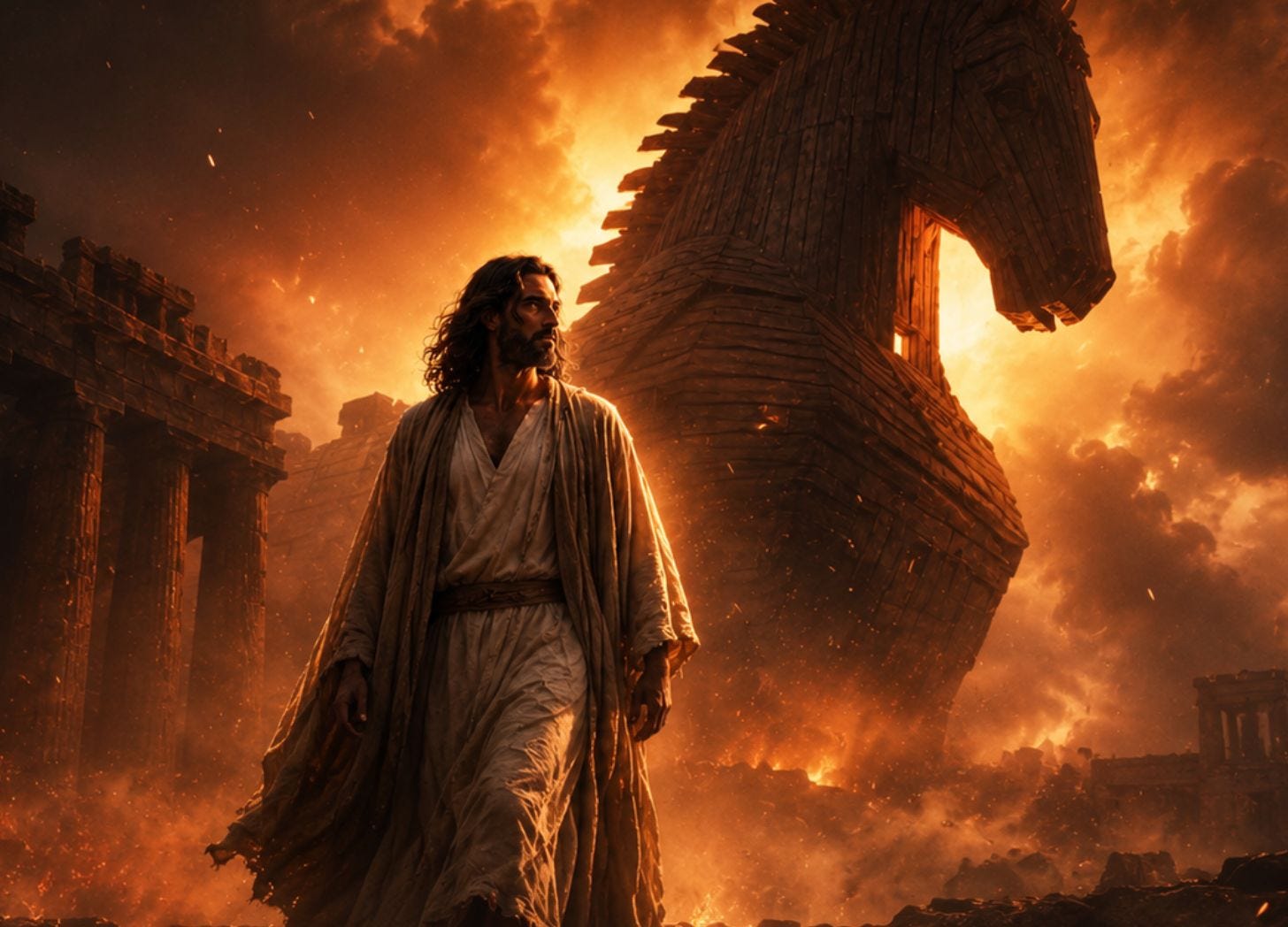
It’s a powerful moral story, and it’s one found throughout Greek myth, known as theoxeny. It’s also the central story of Christianity.
Jesus is the rightful king “disguised” as an ordinary peasant from Galilee. He is repeatedly misunderstood by the villagers, his relatives and disciples, and religious authorities. Jesus is seen as a mere son of a carpenter, a troublemaking preacher, a wandering healer, and, finally, a condemned criminal. “King of the Jews,” the placard above his head on the cross says mockingly.
His journey is similar to Odysseus’s. Both move through the world in lowly disguise. They are mocked by those who fail to recognize them. They are both moving toward the throne that rightfully belongs to them.
While Nolan doesn’t use the trope elsewhere in the film, it appears repeatedly in Homer’s epic. Athena disguises herself as a young shepherd, a young girl, and Mentes, an old family friend of Odysseus. The god Hermes likewise appears as a young mortal man when he gives Odysseus the herb that protects him from Circe’s magic.
Elsewhere in Greek myth, we see the god Dionysus, son of Zeus, disguised in human form. He “changed in shape from God to man,” the text says. Demeter appears as the elderly nurse Doso serving in the household at Eleusis. Apollo and Poseidon disguise themselves as mortal laborers, secretly serving King Laomedon while building the walls of Troy.
Zeus and Hermes likewise wander through Phrygia disguised as poor travelers, knocking on doors and testing the hospitality of strangers. Everyone turns them away except the elderly couple Baucis and Philemon. The apparent beggars then reveal themselves as gods, reward their hosts, and destroy the surrounding community that rejected them. Dionysus likewise destroys those who refuse to recognize or honor him.
The Gospels use a similar storyline. Jesus sends his disciples out without money or provisions, making them dependent on strangers for food and shelter. Those who welcome them are promised divine reward; those that refuse them are warned that their judgment will be worse than Sodom’s.
The recurring pattern is easy to spot: the powerless stranger is secretly the divine judge. A god or rightful king appears in a lowly form, remains unrecognized, and allows people to expose their true character through how they treat him.
Circe’s Pigs
In Nolan’s film, the goddess Circe, played by Samantha Morton, entices Odysseus’s men with a feast. But the food does not satisfy them. Their hunger only intensifies until they are eating with a frantic, animal-like desperation.
The scene gradually takes on the atmosphere of a horror film. Circe then reveals her power and transforms the men into a herd of pigs.
Earlier, Odysseus and his crew sail across the sea and land in an unfamiliar foreign territory. He selects twelve men to explore the island, where they encounter the Cyclops: a savage, superhuman figure who lives outside civilization in a cave among his livestock.
Odysseus confronts the monster and asks him to respect the sacred laws of hospitality. The two exchange names, although Odysseus famously identifies himself as “Nobody.” After blinding the Cyclops, the men escape from his cave by hiding beneath his flock of sheep.
Scholar Dennis MacDonald argues that Mark’s story of the Gerasene demoniac draws upon both episodes, combining the terrifying outsider of the Cyclops story with Circe’s transformation of men into pigs. The parallels are striking.
Jesus, whose movement centers on twelve apostles, sails across the sea with his followers into foreign Gentile territory. There they encounter a savage, supernaturally powerful man who lives among burial caves, separated from society. Like the Cyclops, he is so dangerous that no one can restrain him.
Jesus demands his name. The man answers, “Legion, for we are many”—turning the exchange of names into a revelation of the many supernatural beings occupying his body.
Jesus casts the demons out, but he does not simply make them disappear. At their request, he allows them to enter a nearby herd of pigs. The animals then stampede down a steep bank and drown in the sea.
Mark’s story appears to recombine recognizable Homeric elements: a voyage across the sea, twelve companions, a savage figure living beyond civilization, an exchange of names, livestock used in the escape, and men transformed into pigs. MacDonald also sees wordplay in the names: Polyphemus can mean “many-voiced,” while Mark’s demon calls himself “Legion” because “we are many.”
Odysseus’s Scar
At the end of Nolan’s adaptation, we see Matt Damon as Odysseus abruptly pull his foot away when his nurse Eurycleia, played by Kate Fuglei, washes his feet. He’s still disguised as a beggar, but when she feels a scar on his leg from a boar attack in his youth, it instantly reveals he is her long-lost king.
This type of “recognition” scene was a common aspect of ancient drama. It’s called anagnorisis, or the dramatic moment when a character suddenly understands who the stranger really is—and everything in the story changes.
Aristotle discussed this literary device in chapter 16 of Poetics. He defined recognition as the dramatic movement from ignorance to knowledge. He even singled out Odysseus’s scar as a classic example of a character’s hidden identity being revealed through a bodily mark.
John’s Gospel uses the same literary device after the resurrection. Thomas refuses to believe that Jesus has returned unless he can see the nail marks in his hands and place his hand into the wound in his side. When Jesus displays them, Thomas finally recognizes him: “My Lord and my God.”
In The Odyssey, the scar proves that the apparent beggar is really Odysseus. In John, the wounds prove that the mysterious risen figure is the same Jesus who was crucified. Both returning heroes are recognized through the marks violence has left on their bodies.
New Testament scholar Kasper Bro Larsen opens his book, Recognizing the Stranger, with a section titled “Odysseus’ Scar and Jesus’ Wound Marks.” He argues that recognition scenes are among the most important and frequently repeated literary patterns in John’s Gospel. While Jesus’s wounds provide the most striking example, Larsen shows that characters repeatedly misunderstand his identity before suddenly recognizing him.
Mary Magdalene mistakes the resurrected Jesus for a gardener until he speaks her name. The disciples fail to recognize the stranger standing on the shore until a miraculous catch of fish reveals him to be Jesus. Nathanael initially dismisses him as merely a man from Nazareth, while the Samaritan woman gradually recognizes an unknown Jewish traveler as a prophet and Messiah.
In both stories, the reader already knows who the hidden hero is. That is the source of the dramatic irony: the audience watches someone speak to a husband, stranger, king, relative, or god without realizing who is standing before them. It's one of antiquity's favorite literary devices.
Both theoxeny and anagnorisis come together in the story of the Road to Emmaus. After the resurrection, Jesus joins two disciples as an unrecognized traveler, and they invite the apparent stranger to stay and share a meal.
Only when he breaks the bread do they recognize who has been sitting with them. Jesus then vanishes—the ordinary guest suddenly revealed as the risen Lord.
Even his sudden disappearance is a literary trope found in Greek myth as a device to show divinity. In The Odyssey, Athena repeatedly appears as an ordinary stranger and then flies away like a bird, revealing that the visitor was actually a god.
Omens and Foolish Men
The literary and mythical patterns connecting the story of Jesus, The Odyssey, and surrounding Greek myths are striking.
Odysseus’s return is announced by gods, prophets, dreams, and omens long before it occurs. Other prophecies warn characters of approaching danger. Aegisthus is warned by Hermes that murdering Agamemnon will bring about his own destruction, but he proceeds anyway and is eventually killed by Orestes.
In the underworld, the prophet Tiresias warns Odysseus not to harm the sacred cattle of the sun god Helios. If his men kill them, their ship will be destroyed and none of them will survive. Nolan includes this episode in his adaptation.
Christian tradition holds that Jesus descended into Hades between his crucifixion and resurrection, entering the realm of the dead before returning to life. Odysseus likewise journeys into the underworld, where he encounters Agamemnon—played by Benny Safdie—speaks with the departed, receives revelations, and then returns to the living world.
Odysseus returns to find his starving crew eating the cattle. Eurylochus, played by Himesh Patel, insists they had no other choice. By defying the prophecy, the men bring about the destruction they were warned would come.
The Gospels use prophecy in much the same way. Jesus repeatedly predicts his betrayal, death, and resurrection, but his disciples resist or fail to understand him. They continue moving toward the very events he has foretold, making their confusion and opposition part of the divine script.
In both stories, prophecy heightens the drama by telling the audience what is coming before the characters understand it. We watch in suspense as they ignore warnings, make disastrous choices, and stumble toward the tragedy already foretold.
This pattern of stumbling into catastrophe runs throughout both the Gospels and The Odyssey. Jesus and Odysseus are hero figures who lead bands of men through danger, confronting monsters, demons, hostile rulers, and other powerful forces determined to stop them.
Yet their followers repeatedly become part of the problem. Their failures supply both comedy and tragedy: they misunderstand warnings, panic under pressure, disobey instructions, and make disastrous choices. This heightens the suspense while making the hero appear wiser, more powerful—and increasingly alone.
Himesh Patel’s Eurylochus serves as Odysseus’s second-in-command. In Nolan’s adaptation, he and the crew force Odysseus to remain behind while they search for food. Without their leader, they walk straight into Circe’s trap and are transformed into pigs.
Eurylochus repeatedly fails to trust Odysseus, ignoring him near the whirlpool and helping lead the crew toward ill-fated decisions. By the time the starving men slaughter the sacred cattle, their recklessness has made catastrophe feel almost inevitable.
Jesus’s disciples are similarly clumsy and, at times, panicked. They misunderstand his parables, resist his predictions of death, and fall asleep when he needs them most. One betrays him, another denies him, and after his arrest, the rest abandon him.
Homer establishes this characteristic from the poem’s opening lines, calling Odysseus’s men nēpioi—childish fools whose recklessness brings about their own destruction.
The Gods
One of the central gods in The Odyssey is Zeus, son of Cronus and ruler of the Olympians. Nolan’s characters repeatedly invoke “Zeus’s law,” while thunder and lightning signal the presence of divine power.
Greek mythology was filled with divine sons. Dionysus was the son of Zeus and the mortal woman Semele. Heracles and Perseus were likewise sons of Zeus and human mothers, while Asclepius was born to Apollo and the mortal Coronis.
By the time Matthew and Luke portrayed Jesus as the child of a human mother and divine father, the basic concept was already familiar across the Mediterranean world. The title “Son of God” would not have sounded new—it also carried important Jewish meanings connected to Israel’s kings and Messiah.

Learn more in the new book from leading cult reporter Be Scofield, The Savior Complex: How Jesus Became the World’s Ultimate Influencer.
Poseidon, god of the sea, also plays an important role in Nolan’s adaptation. As the father of the Cyclops Polyphemus, he curses Odysseus and turns the sea itself against him.
Here we find another striking parallel with Jesus. Poseidon gave his sons the unique gift of being able to walk on water. In Astronomy, an ancient poem traditionally attributed to Hesiod and often dated to around 700 BCE, the giant hunter Orion is given the power to “walk upon the waves as though upon land.” Another son of Poseidon, the Argonaut Euphemus, was given the power to run across the gray sea, only getting the tips of his toes wet.
By the time the Gospel writers had Jesus walk on water, citizens of the ancient world were familiar with the idea.
Dionysus is briefly mentioned twice in The Odyssey. Among the Greek gods, he perhaps most closely resembles Jesus. Both are gods disguised as human—divine sons born to mortal women. They each perform wonders involving wine and bring judgment upon those who refuse to recognize them. In pre-Christian Dionysian traditions extending back centuries before Christianity, Dionysus was said to have been violently dismembered and later restored to life or resurrected. Their opponents also call both figures fraudulent.
Godlike Men
Being a divine son had a political meaning as well. Coins with the face of Caesar Augustus identified him as a “Son of God.” Augustus was also praised as lord, savior, and benefactor. The term gospel, or “good news,” was used for imperial announcements concerning Augustus, including decrees celebrating his birth and rule. Scholars have noted that Paul and Jesus’s early followers explicitly borrowed these titles over and against the Roman Empire.
Real rulers like Augustus had superhero biographies—it wasn’t only mythical characters. Alexander the Great’s birth story included magi long before Matthew’s story of Jesus. Plutarch says that on the same night Alexander was born, the Temple of Artemis at Ephesus burst into flames. By morning, the local Magi were running through the streets crying out that the destroyer of Asia had been born. The omen pointed to Alexander’s future invasion of Persia and his violent conquering of the East.
In Resurrection and Reception in Early Christianity, scholar Richard C. Miller points to a wider cluster of shared heroic motifs between Jesus and Alexander. Both biographies establish an exalted lineage. Plutarch begins by linking Alexander to mythic royalty: “As for the lineage of Alexander, on his father’s side he was a descendant of Heracles through Caranus, and on his mother’s side a descendant of Aeacus through Neoptolemus.” Alexander is placed into the family tree of the Greek world’s greatest legendary heroes.
Matthew uses the same narrative device to open his Gospel. Its first line reads: “An account of the genealogy of Jesus the Messiah, the son of David, the son of Abraham.” With one sentence, Matthew places Jesus inside the two most important ancestral lines in Jewish memory. He then uses a curated list of patriarchs and kings to prove that his hero has the right credentials.
Miller cites other examples of striking similarities: both biographies surround the hero’s birth with divine parentage, place the human father in crisis over a supernatural pregnancy, and resolve that crisis through dreams or omens. Both also use proskynesis—ritual bowing before a ruler—to announce the arrival of a world king.
Plutarch reports traditions portraying Alexander as divinely conceived and connected to Zeus. His body supposedly released a supernatural sweetness, while his famous “melting glance” contributed to his superhuman image. Other writers claimed that the sea itself withdrew so Alexander and his army could pass along the coast of Pamphylia.
After Augustus died in 14 CE, the Roman Senate declared him divine. A senator swore that he had actually witnessed Augustus ascending to the gods, which echoed the ancient story of Romulus. His cult—already flourishing in parts of the Greek East during his lifetime—was supported by temples and priests, with sacrifices, festivals, and rituals across much of the empire. He provided early Christians with a powerful model and rival: a divine world ruler credited with saving humanity and bringing peace. Before Jesus, Augustus was perhaps the most worshipped person in existence.
The process of a mortal human transforming into a divine being was known as apotheosis. Whether through official decree, public worship, heavenly ascent, or stories of their bodies vanishing, certain figures such as exceptional rulers and heroes could achieve this divine status. Romulus and Augustus were among the most famous examples.
The Ancient Literary World
The Odyssey is almost one giant experiment in hospitality—it is one of the tale’s defining themes. Nolan’s adaptation makes the motif feel immediate and dangerous: every time the crew reaches a new shore, the viewer waits anxiously to discover whether the strangers will be welcomed, deceived, or attacked.
The same is true of the Gospels, particularly Luke. People’s homes, roads, and dinner tables become moral testing grounds where people reveal themselves through how they receive Jesus and his emissaries. Those who offer hospitality are given blessings and salvation, while rejection brings judgment.
One poignant example comes when Jesus enters the home of Simon the Pharisee. Simon offers him no water for his feet, no welcoming kiss, and no oil for his head. An unnamed woman performs the neglected acts instead, turning Simon’s failed hospitality into a literary device that elevates the social outsider above one of Jesus’s religious rivals.
That resembles the hospitality scenes in The Odyssey, where the treatment of a vulnerable visitor exposes the host’s true character. Polyphemus and the suitors violate the sacred rules, while Eumaeus and the Phaeacians fulfill them.
In Nolan’s adaptation, Odysseus and his crew refer to this sacred obligation as “Zeus’s law.” It hangs over the entire story, shaping their choices and, at times, haunting their consciences.
Aristotle also identified another central device of ancient storytelling: the “scene of suffering,” or pathos. “The Scene of Suffering is a destructive or painful action, such as death on the stage, bodily agony, wounds, and the like,” he writes in the Poetics. Such scenes filled Homeric epic and Greek tragedy, carefully arranged to evoke pity, fear, horror, and awe.
The educated, Greek-speaking Gospel writers belonged to a world steeped in these spectacles of suffering. Audiences knew Philoctetes crying out from the agony of his festering wound, Heracles writhing inside a poisoned robe, Pentheus being torn apart, and Prometheus chained and tormented for defying Zeus. They also knew of Oedipus blinding himself and emerging covered in blood, and Ajax falling upon his sword after humiliation and madness.
When constructing the execution of Jesus—what Christians call the Passion—the Gospel writers likely drew upon both this Greek dramatic world and Jewish traditions of righteous martyrs. They transformed a Roman execution into an extended spectacle of betrayal, abandonment, and mockery that contained whipping, bodily torment, lamentation, and death.
These were well-established literary tools for revealing a hero’s character and overwhelming the audience with things like pity and grief or fear and admiration. Through this lens, the Passion is a carefully staged “scene of suffering” designed to give his death its maximum emotional and theological force.
Aristotle placed the scene of suffering alongside another powerful literary device: peripeteia, or reversal. This is the moment when the action suddenly turns into its opposite—when apparent victory becomes defeat, or disgrace becomes triumph. He gives an example: “Lynceus is being led away to his death, and Danaus goes with him, meaning to slay him; but the outcome of the preceding incidents is that Danaus is killed and Lynceus saved.”
The Passion of the Christ features this dramatic reversal. Jesus is mocked as a king and condemned as a criminal. He is abandoned and crucified. Then he is killed. The resurrection overturns every apparent aspect of this scene: the criminal is revealed as the rightful ruler, defeat becomes a victory, shame is turned into glory, and death becomes the path to immortality. Those who thought they were judging Jesus are recast as the people who will one day be judged by him.
Imagine the emotional release: the reader is carried from a bloody, tortured body to a divine revelation. What looked like catastrophe is unveiled as spiritual triumph.
The Empty Tomb
In the story of Iphigenia, a young woman appears to be sacrificed but mysteriously vanishes from sight and is transported to another land. Aristotle summarizes the plot in the Poetics, saying that she “disappeared unseen” from those sacrificing her.
In a popular version of the story Iphigenia did not die but was transformed by Artemis into the goddess Hecate. Other Greek communities honored her as a heroine.
Iphigenia belongs to a recurring ancient pattern that scholar Richard C. Miller calls the “translation fable”—using translation in its older sense of being transferred or carried away. These stories often involve a body vanishing at the moment of death, an empty resting place or tomb, or the missing person later appearing alive. The missing body often functioned as evidence of apotheosis—the elevation of a mortal into divine status. The person had been removed from the human world and carried into the realm of the gods.
The Odyssey has no empty tomb, yet its entire plot begins with an absent body—a missing king. Odysseus has vanished without a corpse or a grave. There was no reliable account of his death. After twenty years away, he “miraculously” returns alive to a world that has begun treating him as dead.
Professor Robyn Faith Walsh notes that scholars have identified over one-hundred translation fables, many of which are documented in Miller’s Resurrection and Reception in Early Christianity. These stories of missing bodies and divine figures vanishing were common literary conventions used to impart divine status on a character.
One of the most famous was the story of Romulus, Rome’s legendary founder. Born to the Vestal Virgin Rhea Silvia and supposedly fathered by the god Mars, Romulus later vanished during a violent storm. With no body recovered, the Romans were told that their king had been taken up among the gods.
Romulus then appeared to Julius Proculus as he traveled along a road. Proculus publicly swore a sacred oath that he had seen the missing king in shining armor and that Romulus had announced his return to heaven. The Romans accepted the testimony and worshipped Romulus as the god Quirinus.
The Odyssey has no empty tomb, yet its entire plot begins with an absent body—a missing king.
The story of Aristeas, recorded by the fifth-century BCE historian Herodotus, substitutes an empty room for an empty tomb. Aristeas entered a textile shop in Proconnesus and suddenly died. The owner closed the shop and went to notify his relatives.
Yet a traveler insisted that he had just encountered Aristeas alive on the road and spoken with him. When the family arrived carrying everything needed for the burial and opened the shop, the body had completely vanished. Seven years later, Aristeas reportedly returned to the city, composed a poem, and disappeared again.
Another poignant example is that of Cleomedes of Astypalaea. He was a historical figure—an athlete who competed in the Olympic Games around 492 BCE. After killing an opponent during a boxing match, he was denied the victory and reportedly descended into madness. He later destroyed a school filled with children and fled from the enraged townspeople.
Cleomedes took refuge inside a large chest in a sanctuary of Athena and pulled the lid shut. When the townspeople finally smashed it open, they found no one inside—“neither alive nor dead.”
Confused by the vanished body, they consulted the Oracle of Delphi. The oracle declared Cleomedes the “last of the heroes” and ordered the people to honor him with sacrifices because he was “no longer mortal.” From then on, he was worshipped as a hero.
Another ancient missing-body story involves Alcmene, the mother of Heracles. Plutarch reports that as her body was being carried out for burial, it suddenly vanished. When the mourners examined the funeral platform, they found a heavy stone lying where her corpse had been.
One tradition says Zeus ordered Hermes to carry Alcmene to the Islands of the Blessed and replace her body with the stone. The missing corpse signaled that she had escaped ordinary death and been transported into a divine realm.
These are only a few examples. Ancient literature was filled with stories of vanished bodies, empty “tombs,” and missing corpses—narrative signs that the dead had become divine.
Writing Jesus
The Gospel writers crafted the story of Jesus within a world deeply shaped by epic works such as The Odyssey. As educated Greek writers, they would have learned the language through exercises that included copying, memorizing, and reciting Homer and other canonical authors. They wrote within a “cinematic universe” filled with hidden gods, dangerous voyages, divine sons, miraculous births, wonder-working heroes, and mortals carried into heaven. They also used the familiar dramatic machinery of ancient literature: recognition, reversal, prophecy, dramatic irony, and carefully staged scenes of suffering.
Christopher Nolan’s Odyssey helps modern audiences see the literary and mythic world in which the Gospels were written. Once we recognize its patterns, the Gospels look like some of antiquity’s most ambitious narrative creations: polished, purposeful, and carefully constructed to reveal their hero as the divine ruler of the world.
Learn more in the new book The Savior Complex: How Jesus Became the World’s Ultimate Influencer by leading cult reporter Be Scofield.
This could have been written without overt reference to Nolan's dreadful parody and been much the better for it.